Just for fun. The stories in the gold boxes are legends, ghost stories, tall tales and rumors: things people in Georgia tell, not things that are proven, and some are plainly false. We include them because they are part of Georgia’s folklore. Everything outside the gold boxes is fact, checked against the sources listed at the end (the first three on September 17, 2026, the rest on October 2, 2026).
Georgia Legends: Told ’Round Here
You’ve collected 0 of 30 legends. Read one and it’s stamped into your collection on this device.
Every corner of Georgia has a story people tell about it: a sea serpent in the Altamaha, friendly ghosts on Jekyll Island, a cannon that never worked and a mountain traded for a mule. Here are thirty of them, each with the story as it is told and then what is actually true.
We only include a legend if a reputable source (the New Georgia Encyclopedia, the Georgia Historical Society, a state agency, a newspaper or the place itself) records it as a story people tell. That makes it a real legend. It does not make it true.
Jump to: Ghosts · Creatures · Myths, checked · Origin stories · More on our guides. Planning a trip? The Georgia Legends Trail groups every story by region.
Sautee and Nacoochee: the Nacoochee Valley near Helen
What is actually confirmed?
The New Georgia Encyclopedia calls this perhaps the state’s best-known local legend, and is direct about its origin: it is “not an authentic Native American narrative.” Folklorists class it as a typical lovers’-leap story that has become an emblem of local identity in the White County hills.
The mound itself is real, and older than the legend suggests. The Nacoochee Mound is a Late Prehistoric earthen platform mound on the upper Chattahoochee River. It was excavated in 1915 — one of the earliest scientific excavations of its kind in Georgia — which uncovered at least two mound stages and 75 human burials. Archaeologists think it served as a local administrative center in the late 15th and early 16th centuries.
Can you see it?
Yes, from the road. The original mound was completely excavated; a reconstruction stands on private property in the Nacoochee Valley, just off Highway 75 at the Unicoi Turnpike, near Helen. View it from the roadside and do not walk onto the land. It is a few minutes from town — see Blue Ridge vs Helen and where to stay in Helen.
The lost Confederate gold: Washington and Lincoln County
What is actually confirmed?
More than most legends can claim. According to the New Georgia Encyclopedia, a treasure train left Danville, Virginia, on April 6, 1865, carrying $327,022 in gold and silver coins, along with bullion, donated jewelry and even floor sweepings from the Dahlonega mint. The remaining funds from the Richmond banks were left in Washington, Georgia.
On May 24, 1865, bandits attacked wagons that had stopped for the night at or near the Chennault Plantation in Lincoln County. A Union search for the missing gold followed, and the Chennault family was arrested and tortured — then found to be innocent. That is the documented core of the legend: real money, a real robbery, and gold that was never fully traced.
How can you see the real history?
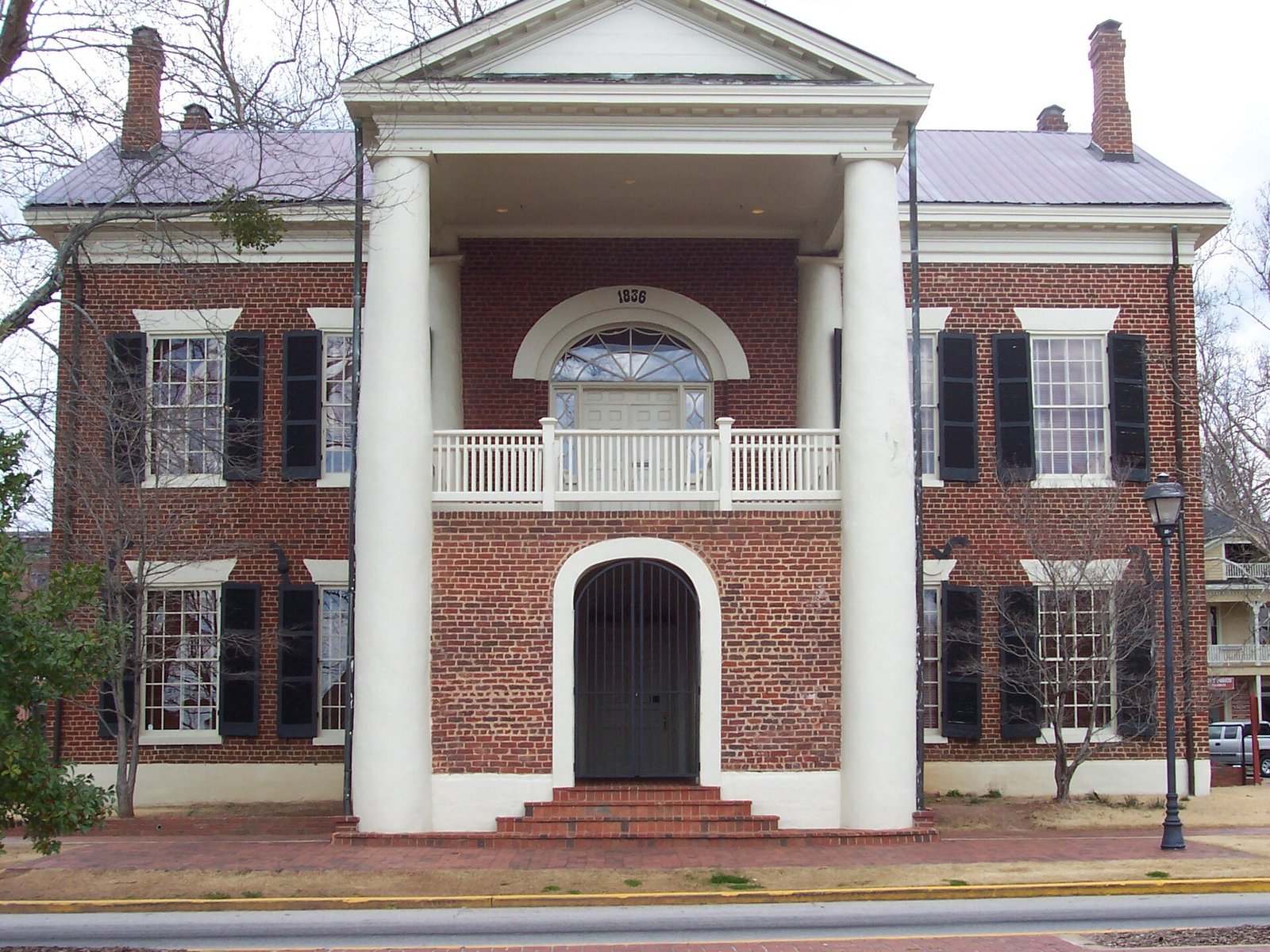
Start with the gold itself at the Dahlonega Gold Museum State Historic Site, in the 1836 Lumpkin County Courthouse — one of Georgia’s oldest standing courthouse buildings. The U.S. Branch Mint in Dahlonega coined more than $6 million in gold between 1838 and 1861, and the museum displays a complete set of those coins and a nugget of more than five ounces (checked ).
- Admission: $10 adults, $7.50 seniors, $7 youth 6–17, $3.50 young children.
- Hours: Monday–Saturday 9 a.m.–4:45 p.m., Sunday 10 a.m.–4:45 p.m.; closed Thanksgiving, Christmas and New Year’s Day.
- Address: 1 Public Square, Dahlonega; 706-864-2257.
- Please don’t go treasure hunting. Digging or metal-detecting on private land without permission is trespassing, and it is not allowed at historic sites.
More on the town in Dahlonega Gold Rush Days.
Okefenokee tall tales: Fargo and the swamp
What is actually confirmed?
The storytelling tradition is well documented. The New Georgia Encyclopedia records that the swamp is the subject of legends, tall tales and personal-experience stories about bears, alligators and the natural world, and that naturalist Francis Harper documented the region’s speech, tales, music and beliefs from 1912 to 1951.
It names fishing guide Lem Griffis, who died in 1968, as Georgia’s best-known traditional storyteller: he entertained visitors at his fish camp outside Fargo with well-practiced “whoppers.” The swamp’s real history is just as striking — at different times it sheltered Native people, people escaping slavery, Civil War deserters and others who needed to disappear.
How do you visit?
- Okefenokee State Park is on the swamp’s western edge at 17515 Highway 177, Fargo; 912-637-5274. It was formerly Stephen C. Foster State Park.
- Cost: the standard Georgia State Parks fee of $10 per vehicle per day, or a $70 annual ParkPass (checked ).
- Dogs: leashed (6 ft) on state park grounds; not in buildings or swimming areas.
- Compare it with every other park in every Georgia state park, compared.
Want to check the policy at a specific Georgia attraction? See our 303-attraction Georgia dog-policy database.
Ghosts and friendly spirits
The friendly ghosts of the Jekyll Island Club
What is actually true: Golden Isles Magazine collected these stories from the Jekyll Island Authority’s own fall ghost tour; they are told as stories, not proven. What is documented: the club was the winter retreat of some of the wealthiest families of the 19th century, including the Rockefellers, the Vanderbilts and the Morgans, and their “cottages” still stand in the Jekyll Island Historic District.
Can you go? Yes. The historic district is open to everyone; see our Jekyll Island guide.
The Marshall House, Savannah
What is actually true: Visit Savannah says the hotel is rumored to be haunted and calls its spirits “some of Savannah’s friendliest ghosts”; nothing proves it. What is documented: Mary L. Marshall opened the hotel in 1851, Union troops used the building as a hospital until the end of the Civil War, and a small museum on the third floor shows prints, newspapers and letters from that time.
Can you go? It is a working hotel; Visit Savannah says guests are invited to see the third-floor collection. For a guided evening, see our ghost tours guide.
The Surrency haunting, Appling County
What is actually true: The AJC tells it as a classic Georgia Halloween tale: the house belonged to a family named Surrency, in the Appling County town of the same name, about 90 miles southwest of Savannah. Nobody ever explained what happened, and the AJC’s headline says it plainly: still a mystery.
Can you go? There is nothing to see in Surrency today. For real haunted history you can walk, see our ghost tours guide.
Creatures and tall tales
Altie, the Altamaha River sea serpent, Darien
What is actually true: Explore Georgia records Altie as local lore and says the tales grew when Scottish settlers from Inverness brought Loch Ness stories with them. No one has ever proved the creature exists. Darien has embraced it anyway: there is a replica of Altie at the Darien-McIntosh Regional Visitor Information Center, and Explore Georgia names Fort King George Historic Site as one of the most popular places to look.
Can you go? Yes. Darien is a stop on our Georgia coast road trip; the Altie replica makes a good photo.
Georgia Bigfoot, Pike County and Cherry Log
What is actually true: There is no confirmed evidence that Bigfoot exists. Explore Georgia notes that a cast of a giant footprint found along Elkins Creek in Pike County in 1997 is one of the best-known casts among Bigfoot hunters, and that Expedition: Bigfoot in Cherry Log is a museum devoted entirely to the creature.
Can you go? Yes. Expedition: Bigfoot is in Cherry Log in the north Georgia mountains; see things to do in Blue Ridge for the area.
Myths, checked
Only two people know the Coca-Cola formula
What is actually true: Mental Floss, citing Snopes, calls this much embellished: when only two people knew the formula, each knew all of it, at times at least four people have known it, and the plane rule was likely made up to add mystery. Coca-Cola itself says only a few people in the world know it. The written formula went into a New York bank vault in 1919, came home to an Atlanta bank in 1925, and in 2011 moved to the Vault of the Secret Formula at the World of Coca-Cola in Atlanta.
Can you go? Yes. The vault is part of the World of Coca-Cola; see things to do in Atlanta.
The double-barreled cannon, Athens
What is actually true: The cannon is real, and the Georgia Historical Society calls it the only known one of its kind. John Gilleland designed it and it was cast in the Athens foundry, but it never worked: the two barrels could not fire at exactly the same instant, so the test shot went wild. It has stood at Athens City Hall ever since as a curiosity, and was long used to fire salutes celebrating political victories.
Can you go? Yes. It is outside City Hall in downtown Athens; see things to do in Athens.
The Waving Girl, Savannah
What is actually true: The waving is true. The Georgia Historical Society marker says Florence Martus (1868–1943) lived on Elba Island with her brother, the lighthouse keeper, and that from 1887 to 1931 no ship passed without her waving a handkerchief by day or a lantern by night; the National Park Service adds that ships answered with three blasts of the whistle. The lost sweetheart is the legend: the marker says only that she became the source of romantic legends as sailors told her story in ports around the world.
Can you go? Yes. Her story belongs to the Savannah riverfront; see our Savannah visitor guide.
The Pirates’ House tunnel, Savannah
What is actually true: Savannah Magazine asked the experts. A local historian calls the tunnel story fiction, points out that the restaurant was not called the Pirates’ House until 1953, and says the owners “dreamed up” the Captain Flint tale. A Georgia Power underground engineer told the magazine that crews dig all over downtown and have never found a tunnel to the river.
Can you go? It is a working restaurant, so check its own site for hours; our Savannah visitor guide covers the neighborhood.
Savannah, Sherman’s “Christmas gift”
What is actually true: Mostly true. Smithsonian magazine says Sherman telegraphed Lincoln on December 22, 1864, presenting the city “as a Christmas gift,” and that Lincoln wrote back with “many, many thanks.” Savannah surrendered without a siege and was left standing, which is why so much of the old city survives today.
Can you go? Yes. See our Savannah guide for the historic district.
The “Maya ruins” of Track Rock Gap
What is actually true: The Forest Service says no. In a statement shared by the Society for Georgia Archaeology, it says the rock art and stone landscape at Track Rock Gap were created by Creek and Cherokee people beginning more than 1,000 years ago and continuing into the 1800s, and that there is no archaeological evidence of any link to Maya people or culture.
Can you go? Yes. Track Rock Gap is in the Chattahoochee National Forest; please look and do not touch. See things to do in Blairsville and Hiawassee.
The mystery wall of Fort Mountain
What is actually true: The wall is real and nobody knows for sure who built it. Georgia State Parks describes the “mysterious 855-foot-long wall” and says it is thought to have been built by early Native people, either as a fortification or for ceremonies.
Can you go? Yes. The wall stands on the highest point of Fort Mountain State Park, near the Cohutta Wilderness; see our hidden-gem state parks.
The mule that bought Stone Mountain
What is actually true: The DeKalb History Center records all three versions as folk tales about the mountain’s first change of ownership. None of them is a documented sale.
Can you go? Yes. See our Stone Mountain Park guide.
Where the names and stories came from
“There’s gold in them thar hills,” Dahlonega
What is actually true: The New Georgia Encyclopedia gives the real words, spoken by mint assayer Matthew Fleming Stephenson to miners leaving for California: “Why go to California? In that ridge lies more gold than man ever dreamt of. There’s millions in it!” The miners went anyway and carried his line west, and Mark Twain later gave a version of it to his character Mulberry Sellers in The American Claimant (1892). Georgia’s own gold rush began after gold was found in 1828–29.
Can you go? Yes. The Dahlonega Gold Museum is on the town square; see things to do in Dahlonega.
Brasstown Bald and the great canoe
What is actually true: That legend is on the Georgia Historical Society’s 1958 marker, which also explains the name. The Cherokee name, Itseyi, means “a place of fresh green,” for the grassy summit, and early settlers confused it with a similar word meaning brass. At 4,748 feet, Brasstown Bald is the highest mountain in Georgia.
Can you go? Yes. See things to do in Blairsville and Hiawassee.
The Nunnehi of Blood Mountain
What is actually true: The Georgia Historical Society’s Blood Mountain marker tells this story and says one of the Nunnehi townhouses was said to stand near Lake Trahlyta. Blood Mountain rises to 4,458 feet in the Chattahoochee National Forest.
Can you go? Yes, on foot. See our best hikes in Georgia.
Fairy crosses, Fannin County
What is actually true: The stones are real. Explore Georgia says they are staurolite crystals that form perfect or near-perfect crosses, that they are found in very few places in the world, and that Fannin County has one of the largest concentrations. The luck is the legend.
Can you go? Yes. See things to do in Blue Ridge.
The Tree Spirits of St. Simons Island
What is actually true: Explore Georgia says artist Keith Jennings carved the original faces, that there are now nearly two dozen, and that new ones appear over time. The lost-sailors meaning is the legend that grew around the art. Hunting for them is a family treasure hunt, and the Golden Isles Welcome Center has the locations.
Can you go? Yes. See Jekyll Island vs St. Simons.
Providence Canyon, “Georgia’s Little Grand Canyon”
What is actually true: The New Georgia Encyclopedia says no river carved it: rainwater running off farm fields did. The canyon began forming in the early 1800s, after the forest was cleared for farming and farmers took no steps to stop erosion. By 1850 the ditches were three to five feet deep. Today the park has 16 canyons, some as deep as 150 feet, with 43 colors of sand in the walls.
Can you go? Yes. It is on our Andersonville, Plains and Providence Canyon road trip.
The wolf of Rome, Georgia
What is actually true: They are right. The Digital Library of Georgia says it is a replica of the famous Capitoline Wolf, showing Romulus and Remus, the legendary founders of Rome, Italy, who were said to have been raised by a wolf. The Italian government gave it to the city in 1929.
Can you go? Yes, outside Rome City Hall; see our small towns in Georgia.
The healing waters of Warm Springs
What is actually true: The New Georgia Encyclopedia records the legend that sick and injured Muscogee (Creek) people came to the springs to recover. The water stays at about 88 degrees. Franklin D. Roosevelt visited 41 times between 1924 and 1945, exercising in the warm pools to rebuild his leg muscles after polio, and in 1927 founded the Georgia Warm Springs Foundation, now the Roosevelt Warm Springs Rehabilitation Center. The warm water helped him exercise; it is not a cure.
Can you go? Yes. Roosevelt’s Little White House is a state historic site; see our Pine Mountain and Warm Springs guide.
More legends on our guides
These six live in gold boxes on the guides to the places they belong to:
- Madison, “the town too pretty to burn”
- Spanish armor at DeSoto Falls
- The 1931 Vidalia onion that wasn’t hot
- “Georgia grows the most peaches”
- Don’t walk under the UGA Arch
- The Tree That Owns Itself
Know a legend we should add?
We only include legends whose existence is documented somewhere reliable, and we always separate the story from the record. If you know a Georgia legend we should look into — or you think we have one of these wrong — tell us. Corrections get priority.
FAQ
What is the legend of Sautee and Nacoochee?
It is a lovers’-leap story from the Nacoochee Valley near Helen, in which a Cherokee princess, Nacoochee, and Sautee, from a rival tribe, refuse to give each other up, in a story that ends in heartbreak. The New Georgia Encyclopedia describes it as perhaps the state’s best-known local legend.
Is the Sautee and Nacoochee legend a real Cherokee story?
No. The New Georgia Encyclopedia states that it is not an authentic Native American narrative, but a typical lovers’-leap legend that has become an emblem of local identity.
Can you visit the Nacoochee Mound near Helen?
You can see it from the road. The original mound was excavated in 1915; a reconstruction stands on private property off Highway 75 at the Unicoi Turnpike, so view it from the roadside rather than entering the land.
Is there really lost Confederate gold in Georgia?
Part of the story is documented. A Confederate treasure train carrying $327,022 in gold and silver reached Georgia in 1865, and wagons were robbed near the Chennault Plantation in Lincoln County on May 24, 1865. Whether any gold remains hidden is legend, not established fact.
Who was Lem Griffis?
Lem Griffis was a fishing guide near Fargo, on the edge of the Okefenokee Swamp, and according to the New Georgia Encyclopedia Georgia’s best-known traditional storyteller. He died in 1968.
Is there a sea monster in Georgia?
Only in legend. Altie, the Altamaha-ha, is said to live in the Altamaha River near Darien. Explore Georgia records it as local lore; no one has proved it exists, but there is a replica at the Darien-McIntosh Regional Visitor Information Center.
Do only two people know the Coca-Cola formula?
No. Mental Floss, citing Snopes, says that when only two people knew it, each knew the whole formula, and at times at least four people have known it. Coca-Cola says only a few people know it; the written formula is in a vault at the World of Coca-Cola in Atlanta.
Where did “there’s gold in them thar hills” come from?
From Dahlonega, roughly. The New Georgia Encyclopedia says mint assayer Matthew Fleming Stephenson told miners leaving for California, “There’s millions in it!” Mark Twain later used a version of the line in The American Claimant (1892).
Were Maya ruins found in north Georgia?
No. The Forest Service says the stone features at Track Rock Gap were made by Creek and Cherokee people over more than 1,000 years, with no evidence of any link to the Maya.
How we checked this guide: Dates, hours, admission and parking prices, and access details were verified against the official sources listed below on . Operators change schedules and raise prices without notice, so confirm anything time-sensitive before you drive. The figures in this guide also feed our Georgia Attraction Transparency Index and Family Day-Out Cost Index.
Sources
- New Georgia Encyclopedia — Storytelling Traditions
- New Georgia Encyclopedia — Nacoochee Mound
- New Georgia Encyclopedia — Confederate Gold
- New Georgia Encyclopedia — Okefenokee Swamp Folklore
- Georgia State Parks — Dahlonega Gold Museum State Historic Site
- Georgia State Parks — Okefenokee State Park
- Georgia State Parks — ParkPass
- Explore Georgia — Mystical legends of Georgia folklore
- Golden Isles Magazine — Ghosts + Ghouls: Jekyll tour shares stories of days gone by
- Visit Savannah — 5 things you didn’t know about the Marshall House
- AJC — Surrency haunting still a mystery
- Coca-Cola — Where is the secret formula kept?
- Mental Floss — Does anyone know the whole formula for Coke?
- Georgia Historical Society — The Athens double-barreled cannon
- Georgia Historical Society — The Waving Girl
- National Park Service — Florence Martus
- Savannah Magazine — Beneath the surface
- Smithsonian — Sherman offered Savannah as a “Christmas gift”
- Society for Georgia Archaeology — Track Rock Gap and the Forest Service
- Georgia State Parks — Fort Mountain State Park
- DeKalb History Center — Folk tales: Stone Mountain
- New Georgia Encyclopedia — Dahlonega
- Georgia Historical Society — Brasstown Bald
- Georgia Historical Society — Blood Mountain
- New Georgia Encyclopedia — Providence Canyon
- Digital Library of Georgia — Capitoline Wolf
- New Georgia Encyclopedia — Franklin D. Roosevelt in Georgia

Hank Whitlock is the pen name of the It's Georgia editor. Every guide is built around the questions a busy family actually asks before a trip: how long is the drive, what does parking cost, can the stroller make it, are dogs allowed. Details are checked against official park, city, and venue sources, and each guide shows the date it was last updated.
More from Things to Do


Cite this page: It's Georgia, “Georgia Local Legends: 30 Stories People Tell, and What’s Actually True”, itsgeorgia.com/things-to-do/hidden-gems/georgia-local-legends/ (updated ). Free to quote with attribution and a link to this page.