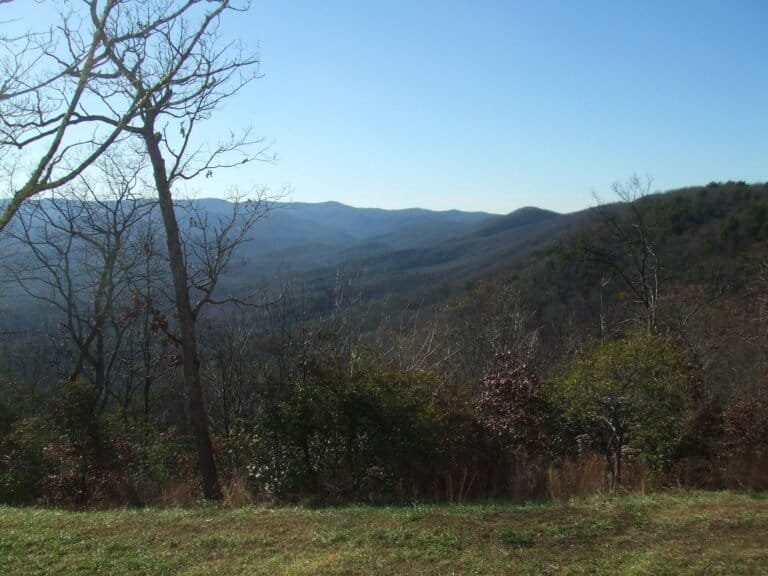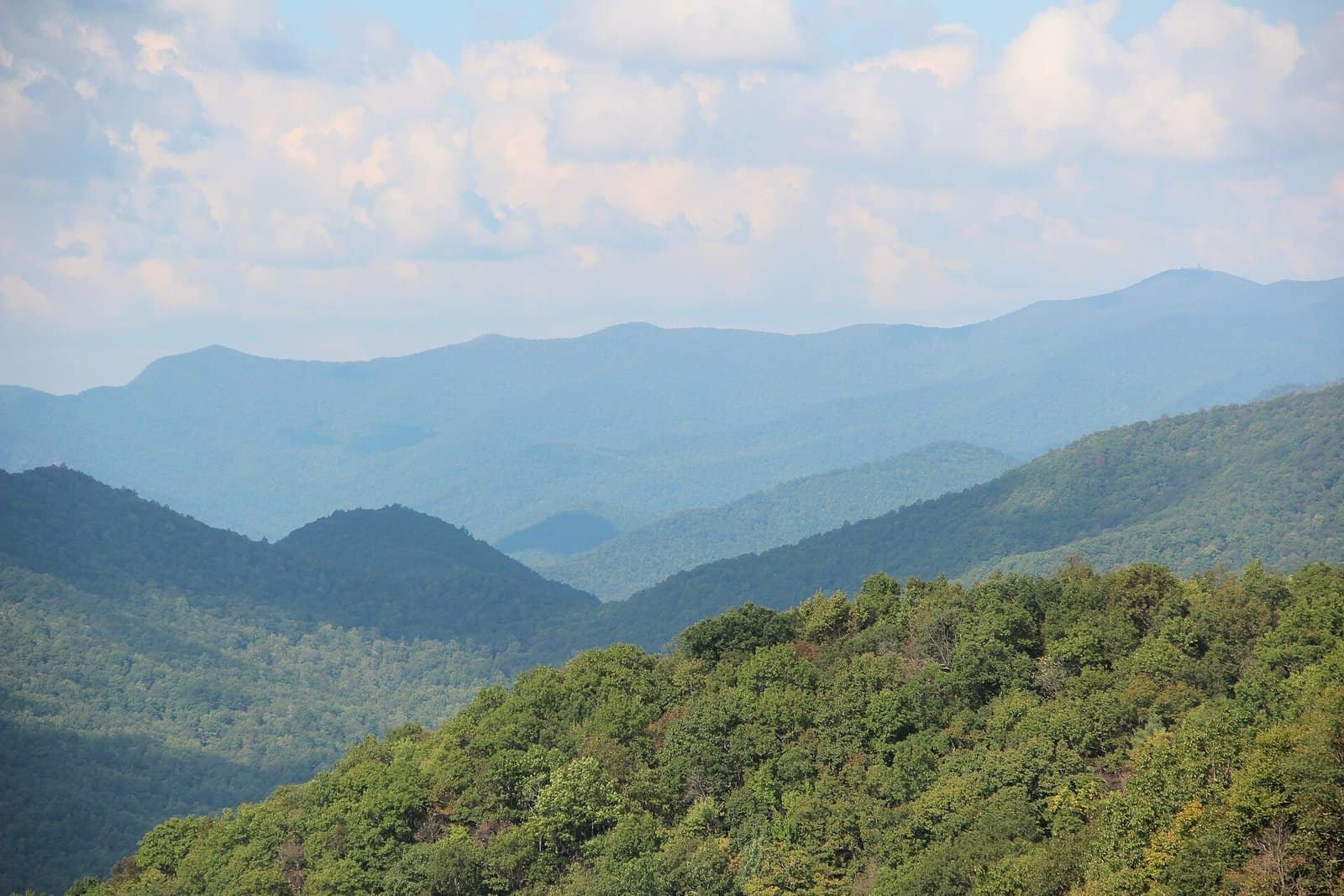
North Georgia’s fall color runs downhill: ground above 4,000 feet — Brasstown Bald and its shoulders — typically peaks in the middle of October, while valleys and foothills below 3,000 feet usually hold on until the last week of October and the first week of November. That is the pattern from the Georgia Forestry Commission’s own past Leaf Watch reports, not a promise about this year.
There is no 2026 forecast yet. The Georgia Forestry Commission states that Leaf Watch 2026 begins on October 1, 2026, and until then the agency publishes no dated prediction. Georgia State Parks, for its part, says only that late October and early November are often the most vibrant days. Anyone telling you that this year’s peak falls on a specific weekend is guessing.
What you can plan is elevation and geography. Color begins in the northeast corner of the state and works west and south. Below are eight places to stand — what each charges, when it opens, and one closure at Vogel that will catch people out this fall.
| Question | Answer |
|---|---|
| When does peak color usually happen? | Above 4,000 ft, typically mid-October. Below 3,000 ft, typically end of October to the first of November. |
| Is there an official 2026 forecast? | Not yet. Georgia Forestry Commission Leaf Watch 2026 begins October 1, 2026. |
| Highest viewpoint in Georgia? | Brasstown Bald, 4,784 feet. $8 per person aged 16+, free for 15 and under; center open daily 10 a.m.–5 p.m. |
| What does state park parking cost? | $10 per vehicle per day, or a $70 annual ParkPass; 50% off for seniors 62+. |
| Best scenic drive? | Russell–Brasstown National Scenic Byway — a 40-mile loop on GA 348, 180 and 17/75. Allow at least three hours. |
| Can we bring the dog? | Yes at Brasstown Bald on a leash, but not inside the visitor center. Leashed dogs on Tallulah’s rim trails only. |
| Anything closed this year? | Yes. Lake Trahlyta at Vogel is drained for dam repairs; the lake loop trail and waterfall are closed. |
When does fall color actually peak in North Georgia?
Read the Forestry Commission’s archived reports and the pattern is consistent. In its October 15 report of the previous season, the agency anticipated that the highest elevations — Brasstown Bald and most locales above 4,000 feet — would be at peak within the following 7 to 10 days. On that same date, north-central Georgia above 3,000 feet was about 45% changed while below 3,000 feet it sat at roughly 15%, and the agency expected the lower areas to peak around the end of October to the first of November.
By the first week of November that season, northwest Georgia was at peak with 95% change above 3,000 feet and 85% below, and in the northeast the high ground was well into peak with understory species already fading while the oaks came on below. The Commission’s summary of the geography is simple: fall colors begin in the northeast part of the state and work their way west and south.
So a rule of thumb, not a calendar. Mid-October for the summits. The last week of October for the 2,500-to-3,500-foot parks — Vogel, Fort Mountain at 2,850 feet, Black Rock Mountain at 3,640. Early November for the gorges and the foothills. Drought, an early freeze or a warm October can shift any of it by a week or more.

Is there an official 2026 peak-color forecast?
No. The Georgia Forestry Commission’s Leaf Watch page states that Leaf Watch 2026 will begin October 1, 2026, and points visitors to the previous year’s reports in the meantime. Once it launches it publishes weekly percentage-change readings by region and elevation band — the single most useful thing to check the night before you drive.
Georgia State Parks runs a parallel Leaf Watch page and notes that Black Rock Mountain, at 3,640 feet, is usually one of the first locations to show vibrant fall color, and that F.D. Roosevelt State Park south of Atlanta often peaks during early November. Neither agency publishes a dated 2026 prediction as of mid-September. Check both in October.
Brasstown Bald
Georgia’s highest point at 4,784 feet, and the first place in the state to turn. The Forest Service visitor center at 2941 Highway Spur 180, Hiawassee, is open seven days a week from 10 a.m. to 5 p.m., closed the day before Thanksgiving, Thanksgiving, Christmas Eve and Christmas. Day use is $8 per person aged 16 and over, $5 per person after hours, and free for children 15 and under; America the Beautiful and Interagency Senior passes are accepted.
From the parking area it is a 0.6-mile paved foot trail to the summit, which the Forest Service describes as very steep. A shuttle runs during operating hours with your admission — last shuttle up is 4:30 p.m., and there is no service between 12:30 and 1:10. Dogs must be leashed and are not permitted inside the visitor center. Reckon on two hours from Atlanta.
Richard B. Russell Scenic Highway and the byway loop
GA 348 — the Richard B. Russell Scenic Highway — is the climbing section of the Russell–Brasstown National Scenic Byway, a 40-mile loop the Forest Service runs across State Highways 348, 180 and 17/75, encircling the headwaters of the Chattahoochee. The agency recommends allowing at least three hours’ driving time and calls the drive ideal for viewing dazzling fall color.
Stops on or beside the loop include Dukes Creek Falls, Mount Yonah, the Raven Cliffs Wilderness, the Appalachian Trail crossing at Hogpen Gap, Brasstown Bald, Smithgall Woods, Andrews Cove Campground, Unicoi State Park, Anna Ruby Falls and Helen. Because it climbs from valley floor to ridge, the loop shows several stages of color in one afternoon — which makes it the most forgiving option when you have mistimed the peak. If you are staying over, see where to stay in Helen.
Blood Mountain and the Byron Herbert Reece trailhead
The classic high-ridge hike, and the hardest one to park at. The Byron Herbert Reece trail leaves US 19/129 just north of Neels Gap and climbs 400 feet to a three-way intersection south of Flat Rock Gap, from which Blood Mountain is a further 1.5 miles along the Appalachian Trail. Parking is free, but there are only 24 paved spaces and 14 gravel ones — 38 vehicles at most — and the Forest Service describes this as the most heavily used portion of the Appalachian Trail in Georgia with limited parking availability. On an October Saturday, arrive before 9 a.m. or go elsewhere.
The trail lies almost entirely within the Blood Mountain Wilderness, so expect few structures, signs or blazes. The Forest Service has also posted an advisory that recent impacts from Storm Fern left downed trees, unstable footing and other hazardous conditions along portions of the Appalachian Trail — check the forest’s alerts page before you set out. For gentler alternatives see our roundup of easy hikes near Atlanta with kids.
Vogel State Park
Vogel sits at 2,500 feet at 405 Vogel State Park Road, Blairsville, open 7 a.m.–10 p.m. with the office 8 a.m.–5 p.m., and the park describes itself as particularly popular in fall when the Blue Ridge turns red, yellow and gold. But check the closure before you go: Lake Trahlyta is currently drained for dam repairs and maintenance, and the Lake Trahlyta Loop Trail and the waterfall are closed.
That matters: the flat lake loop was why many families chose Vogel. With it closed, Vogel is a picnic-and-drive stop this season rather than a stroller destination — for that, see our stroller-friendly waterfalls guide.
Amicalola Falls State Park
The 729-foot cascade at 418 Amicalola Falls State Park Road, Dawsonville, is the tallest cascading waterfall in the Southeast and the lowest-elevation stop on this list, which makes it a late-season choice — color here holds after the summits have dropped. The park is managed for Georgia State Parks by the North Georgia Mountains Authority and Coral Hospitality, and a daily ParkPass applies.
It is also the most forgiving for mixed-ability groups, with a driveable upper lot near the top of the falls as well as the staircase from below. Our Amicalola Falls State Park guide covers the stairs, lots and lodge in detail.
Tallulah Gorge State Park
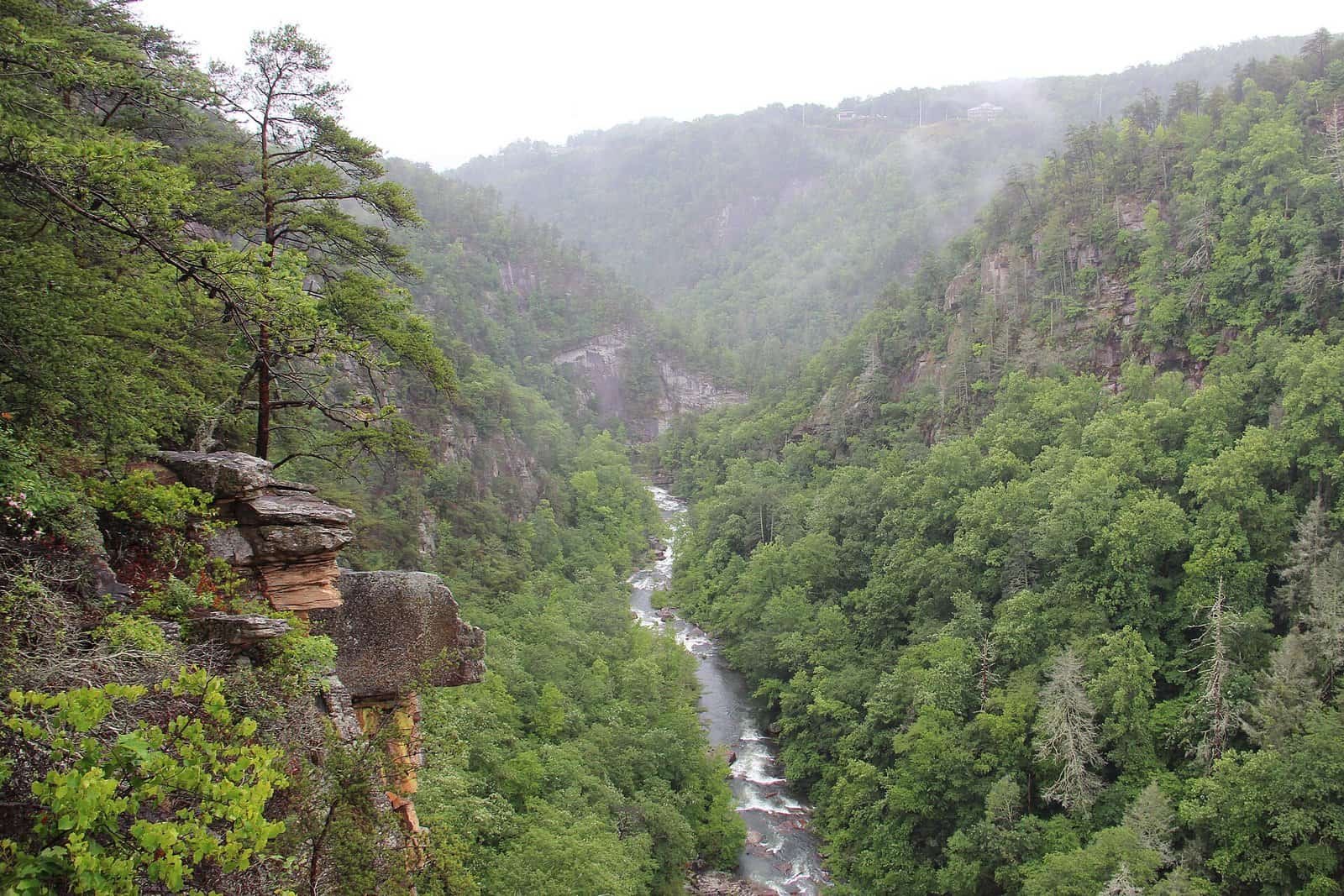
At 338 Jane Hurt Yarn Drive, Tallulah Falls, open 8 a.m. until dark. The rim trails and the suspension bridge — which sways 80 feet above the rocky bottom — give you the color without the commitment. Leashed pets are welcome on rim trails but banned from the gorge floor, the sliding rock trail and the Hurricane Falls staircase.
Two November specifics shape a fall visit. Free gorge-floor permits are limited to 100 per day, cannot be reserved in advance, and are issued after safety briefings that start promptly at 8 a.m., 10 a.m. and noon while supplies last; proper footwear is required and the park does not recommend the floor for children eight or younger. And the park schedules whitewater releases of 500–700 cfs on the weekends of November 7–8, 14–15 and 21–22, with aesthetic releases of 200 cfs on November 1 and those same weekends. Gorge access is restricted on release dates — which is precisely when the water is most photogenic from the rim.
Black Rock Mountain State Park
Georgia’s highest state park at 3,640 feet, at 3085 Black Rock Mountain Parkway in Mountain City, open 7 a.m.–10 p.m. Its roadside overlooks give what the park describes as spectacular 80-mile vistas over the Appalachian forest — meaning you get the view without a hike, which is the whole point with small children or tired grandparents in the car.
Georgia State Parks notes Black Rock is usually one of the first locations in the system to show vibrant fall color, so aim for a mid-October weekend. It is about two hours up US 441, pairing neatly with the Rabun County orchard in our apple picking guide.
Cloudland Canyon State Park
The northwest corner option, on the western edge of Lookout Mountain at 122 Cloudland Canyon Park Road, Rising Fawn, open 7 a.m.–10 p.m., interpretive center 10 a.m.–5 p.m. weekends. Thousand-foot-deep canyons, sandstone cliffs and waterfalls make the overlook trail one of the state’s best color walks, and northwest Georgia tends to peak slightly after the northeastern high ground.
How do the viewpoints compare?
| Place | Drive from Atlanta (approx.) | Cost | Elevation and typical peak | Dogs | Best for |
|---|---|---|---|---|---|
| Brasstown Bald | ~2 hr | $8 per person 16+; under 16 free | 4,784 ft; typically mid-October | Leashed, not in center | The earliest and highest color |
| Russell–Brasstown Byway (GA 348) | ~1 hr 45 to Helen | Free to drive | Valley to ridge; several stages at once | In your car | Mistimed trips and small children |
| Blood Mountain (Reece trailhead) | ~1 hr 45 | Free parking, 38 spaces | High ridge; typically mid-October | Not published | Hikers who arrive before 9 a.m. |
| Vogel State Park | ~1 hr 45 | $10 ParkPass per vehicle | 2,500 ft; typically late October | Not published | Picnics — lake loop is closed |
| Amicalola Falls State Park | ~1 hr 15 | $10 ParkPass per vehicle | Low; typically late Oct–early Nov | Pet-friendly park | Waterfall plus color, mixed abilities |
| Tallulah Gorge State Park | ~1 hr 45 | $10 ParkPass; gorge floor permit free | Gorge rim; typically late Oct–early Nov | Leashed, rim trails only | Rim views and November water releases |
| Black Rock Mountain State Park | ~2 hr | $10 ParkPass per vehicle | 3,640 ft; among the first to turn | Not published | 80-mile views from the car |
| Cloudland Canyon State Park | ~2 hr | $10 ParkPass per vehicle | Lookout Mountain rim; peaks slightly later | Not published | Northwest Georgia and late color |
What does it cost to park?
Every Georgia State Park in this guide requires a ParkPass: $10 per vehicle for the day, valid at more than one park on the same day, or $70 for an annual pass. Seniors 62 and over get 50% off and active military and veterans 25%, purchased in person. Overnight guests pay the daily fee once per vehicle for the whole stay. Historic sites charge separate admission.
Federal land works differently. Brasstown Bald charges per person — $8 for anyone 16 or over, $5 after hours — and honors America the Beautiful and Interagency Senior passes. The Byron Herbert Reece trailhead is free. Plan three or more park days a year and the $70 annual pass pays for itself; our Georgia Family Day-Out Cost Index sets those numbers against other outings.
What should you do in your situation?
| If you… | Do this | Why |
|---|---|---|
| Can only go one weekend | Drive the Russell–Brasstown Byway | The 40-mile loop crosses several elevation bands, so something is at peak whatever week you pick |
| Have a toddler or a stroller | Black Rock Mountain’s roadside overlooks | 80-mile vistas with no hike; Vogel’s flat lake loop is closed this season |
| Are bringing the dog | Tallulah Gorge rim trails or Brasstown Bald | Leashed dogs are allowed on both, but not on Tallulah’s gorge floor or inside the Brasstown visitor center |
| Are going in early November | Amicalola, Tallulah Gorge or Cloudland Canyon | Lower and western ground holds color after the 4,000-foot summits have dropped their leaves |
| Are on a tight budget | Byway plus the Reece trailhead | Both are free; a $10 ParkPass then covers any state park you add on the same day |
| Want to avoid crowds | Any weekday, and skip Blood Mountain on weekends | The Reece lot holds 38 cars and serves the busiest stretch of the Appalachian Trail in Georgia |
| Get rain or fog on the summit | Drop 1,500 feet and walk a gorge rim | Brasstown Bald’s view disappears in cloud; Tallulah and Cloudland still read well in flat light |
What else fits the same weekend?
The color corridor overlaps almost exactly with the harvest one. Ellijay and Blue Ridge orchards sit beside the I-575 route, and the Dawsonville farms in our pumpkin patches near Atlanta guide are 20 minutes from Amicalola. For a longer loop, our North Georgia mountain road trip strings several of these together. When the leaves are down, the same roads lead to Christmas in Helen, the Christmas towns of Georgia and holiday train rides.
FAQ
When is peak fall foliage in North Georgia?
Typically mid-October above 4,000 feet and the end of October to the first of November below 3,000 feet, based on the Georgia Forestry Commission’s past Leaf Watch reports. Georgia State Parks says late October and early November are often the most vibrant days. No official 2026 forecast exists yet — Leaf Watch 2026 begins October 1, 2026.
Is there a 2026 fall color prediction for Georgia?
Not as of mid-September. The Georgia Forestry Commission states that Leaf Watch 2026 will begin on October 1, 2026, and publishes nothing dated before then. Once live, it reports weekly percentage change by region and elevation band. Georgia State Parks runs a companion Leaf Watch page with park-by-park tips but no dated prediction either.
Brasstown Bald or Black Rock Mountain — which turns first?
Brasstown Bald, by roughly a week. At 4,784 feet it is a thousand feet higher than Black Rock’s 3,640, and past Forestry Commission reports put ground above 4,000 feet at peak in mid-October. Georgia State Parks describes Black Rock as usually one of the first parks in its system to show vibrant color, which puts it just behind.
How much does it cost to visit Brasstown Bald?
Day use is $8 per person aged 16 and over and free for children 15 and under, with a $5 per person rate after hours. America the Beautiful, Interagency Senior, Golden Age and Golden Access passes are accepted. The shuttle to the summit is included; the last one up leaves at 4:30 p.m. and there is no service between 12:30 and 1:10.
Do you have to hike to see fall color in North Georgia?
No. Black Rock Mountain’s roadside overlooks give 80-mile vistas from the car park, the Russell–Brasstown Byway is a 40-mile drive, and Brasstown Bald runs a shuttle to the summit for visitors who would rather not walk the very steep 0.6-mile paved trail. Tallulah Gorge’s rim trails and overlooks also need no descent.
What does a Georgia State Parks ParkPass cost?
Ten dollars per vehicle per day, valid at more than one park on the same day, or $70 for an annual pass. Seniors 62 and over receive 50% off and active military and veterans 25%, in person only. Overnight guests pay the daily fee once for the whole stay. Brasstown Bald is federal land and charges separately, per person.
Is Vogel State Park worth visiting this fall?
For the drive and a picnic, yes; for the walk, less so. Lake Trahlyta is drained for dam repairs and maintenance, and the Lake Trahlyta Loop Trail and the waterfall are closed. That removes the flat, family-friendly loop that made Vogel a stroller favorite. The park at 2,500 feet still colors well in late October.
Can you bring dogs to see the leaves?
Partly. Brasstown Bald allows leashed dogs outdoors but not inside the visitor center. Tallulah Gorge welcomes leashed pets on the rim trails while banning them from the gorge floor, the sliding rock trail and the Hurricane Falls staircase. Amicalola Falls is listed as pet-friendly. The other parks here publish no dog policy on their pages.
What should we do if the summit is in cloud?
Lose elevation. Brasstown Bald’s whole value is the 360-degree view, and in fog it is a $8-per-person walk to a white wall. Drop to the Russell–Brasstown Byway, Tallulah Gorge’s rim or Cloudland Canyon, where color close at hand reads well in flat light and overcast actually saturates the reds.
Are there trail closures to know about?
Two. Vogel’s Lake Trahlyta Loop Trail and waterfall are closed while the lake is drained for dam repairs. And the Forest Service has posted that impacts from Storm Fern left downed trees, unstable footing and other hazardous conditions along portions of the Appalachian Trail — relevant to Blood Mountain via the Byron Herbert Reece trail. Check alerts before hiking.
How we checked this guide: Dates, hours, admission and parking prices, and access details were verified against the official sources listed below on . Operators change schedules and raise prices without notice, so confirm anything time-sensitive before you drive. The figures in this guide also feed our Georgia Attraction Transparency Index and Family Day-Out Cost Index.
Sources
- Georgia Forestry Commission — Fall Leaf Watch (confirms Leaf Watch 2026 begins October 1, 2026)
- Georgia Forestry Commission — Leaf Watch report, October 15 (peak above 4,000 ft, percentage change by elevation band)
- Georgia Forestry Commission — Leaf Watch report, November 6 (northwest and northeast Georgia at peak; season moves west and south)
- Georgia State Parks — Leaf Watch (Black Rock Mountain among the first to color; F.D. Roosevelt peaks early November)
- Georgia State Parks — Leaf Watch release (late October and early November are often the most vibrant days)
- US Forest Service — Brasstown Bald Visitor Information Center (elevation, hours, fees, shuttle, trail, dogs)
- US Forest Service — Russell–Brasstown National Scenic Byway (40-mile loop, highways, stops, driving time)
- US Forest Service — Byron Herbert Reece Trail (free parking, 38 spaces, climb, Blood Mountain distance, wilderness notes)
- US Forest Service — Appalachian Trail in Georgia (Storm Fern hazard advisory)
- Georgia State Parks — ParkPass (daily and annual fees, discounts, exemptions)
- Vogel State Park (elevation, hours, Lake Trahlyta drawdown and trail closure)
- Tallulah Gorge State Park (hours, gorge-floor permits, pet rules, November water release dates)
- Black Rock Mountain State Park (3,640 ft, hours, 80-mile overlooks)
- Cloudland Canyon State Park (hours, interpretive center, canyon description)
- Fort Mountain State Park (2,850 ft elevation)
- Explore Georgia — Amicalola Falls State Park & Lodge (729-foot falls, ParkPass, hours, pet-friendly listing)
- Amicalola Falls State Park & Lodge — official operator site (address, falls height)

Hank Whitlock is the pen name of the It's Georgia editor. Every guide is built around the questions a busy family actually asks before a trip: how long is the drive, what does parking cost, can the stroller make it, are dogs allowed. Details are checked against official park, city, and venue sources, and each guide shows the date it was last updated.